
No single open-weight model wins in April 2026: DeepSeek R2 leads on benchmarks, Llama 4 on ecosystem, and Mistral Sovereign on sovereign deployment, so match each workload to a model rather than picking one answer for everything. Open-weight models are no longer the cheap option. They are a serious enterprise choice.
Within five weeks in March and April 2026, three frontier-class open-weight models hit production: Meta's Llama 4 70B and 405B variants (Meta AI, released 18 March 2026), DeepSeek R2 (DeepSeek release notes, released 2 April 2026), and Mistral Sovereign 220B (Mistral AI announcement, released 9 April 2026). Each targets a different enterprise problem. None of them dominates. The right answer for your workload depends on what you actually need.
This is the comparative read.
The three contenders
Llama 4 ships in two variants: a 70B parameter model designed for single-GPU deployment and a 405B parameter model that requires a multi-GPU cluster. Meta's headline claim is that Llama 4 405B reaches GPT-4o parity on most reasoning benchmarks while running entirely on customer infrastructure. Licence: Meta's community licence, which permits commercial use up to 700 million monthly active users.
DeepSeek R2 is the second-generation reasoning model from the Chinese lab. It ships with extended thinking enabled by default, a 128K context window, and benchmarks that exceed Llama 4 405B on mathematics and code generation. Licence: MIT-equivalent open licence, no commercial restriction. Weights are available globally.
Mistral Sovereign 220B is the EU-hosted model designed explicitly for sovereign deployment. Mistral has partnered with EU and AU cloud providers to offer the model in-region with no data egress. Performance is below Llama 4 405B on raw benchmarks but the sovereignty story is the differentiator. Licence: Apache 2.0.
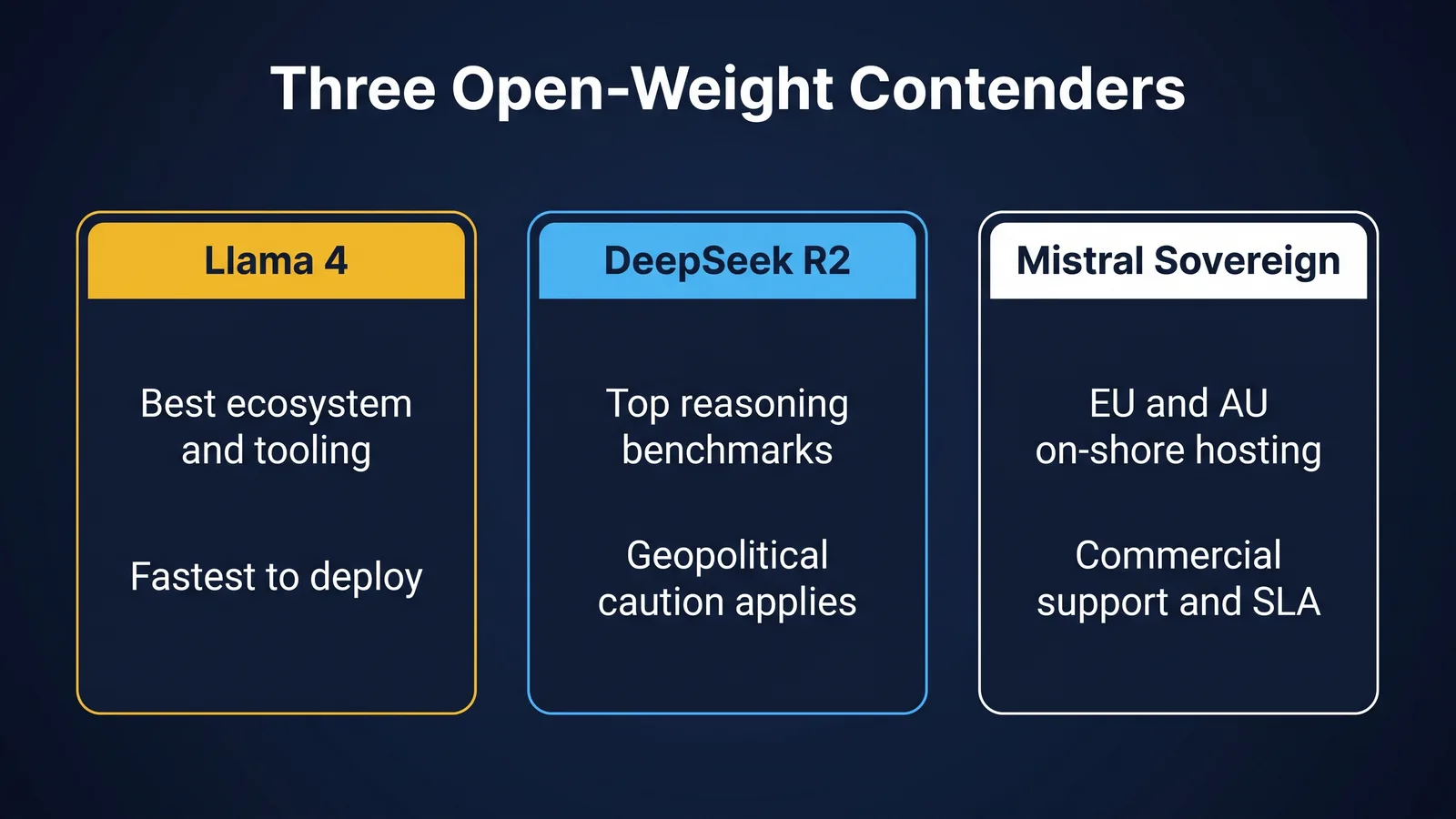
How do Llama 4, DeepSeek R2 and Mistral Sovereign compare?
We tested all three across six axes that matter for enterprise. The picture is not a winner; it is three different right answers depending on what you optimise for.
Performance on reasoning. DeepSeek R2 leads on the GPQA benchmark (graduate-level scientific reasoning) at 78 per cent versus Llama 4 405B at 71 per cent and Mistral Sovereign at 64 per cent (Hugging Face Open LLM Leaderboard, accessed April 2026). On code generation (HumanEval), DeepSeek R2 again leads at 91 per cent. For pure capability per parameter, R2 is the answer.
Ecosystem and tooling. Llama 4 wins this comfortably. The Llama ecosystem has more fine-tuning tools, more deployment options, more integrations with vector databases, more reference architectures. If your engineering team has anyone who has shipped open-weight models before, they have shipped Llama. Time-to-deployment is materially shorter.
Sovereignty. Mistral Sovereign is purpose-built here. Hosted in EU and AU regions through partners including Outscale, OVHCloud and AUCloud, with contractual data residency guarantees. For regulated workloads where data leaving the country is a deal-breaker, this is the only one of the three with a turnkey answer. Llama 4 and DeepSeek R2 can be self-hosted in-region, but the engineering burden falls on you.
Vendor support. Mistral provides commercial support contracts including SLAs and incident response. Meta provides community support and a paid technical support tier through cloud partners. DeepSeek provides community support only with no commercial SLA. For organisations that need a vendor accountable when something breaks at 3am, the order is Mistral, Llama, DeepSeek.
Inference cost. Self-hosted, Llama 4 70B is the cheapest at roughly USD 0.40 per million tokens on a properly utilised cluster. Mistral Sovereign on partner cloud sits around USD 1.20 per million. DeepSeek R2 self-hosted is similar to Llama at USD 0.50 per million but requires more memory due to its extended thinking budget. Compare to GPT-5 enterprise at USD 8 per million input. Open-weight has crossed the cost-effectiveness threshold for any sustained workload.
Geopolitical and supply-chain risk. This is the awkward axis. DeepSeek R2 is published by a Chinese lab. The weights are open and available globally, but several Australian government agencies and large financial institutions have advisories in place that prevent or restrict use of Chinese-origin open models for production workloads. This is not a technical issue but it is a real constraint. Llama and Mistral do not carry the same restriction.
What this actually means
Three patterns are emerging across the early adopters.
First, hybrid deployment is now standard. Most teams running open-weight in production are not running it for everything. They are running it for high-volume, repetitive workloads where the per-token cost of GPT-5 or Claude Opus would be prohibitive, and reserving the closed models for tasks where capability matters more than cost.
Second, the sovereignty story is winning more deals than the cost story. The teams switching to Mistral Sovereign are not switching to save money; they are switching because their compliance team will not approve cross-border data flows. The cost saving is a bonus.
Third, the engineering burden is real and underestimated. Self-hosting a 405B parameter model is not a weekend project. The teams that succeed have a dedicated MLOps function. The teams that fail have a single engineer trying to do it alongside their day job.
Who should care about open-weight models?
If you sponsor an AI program, your model selection should not be a single answer. Your strategy should match workloads to models, not models to workloads.
If you sit in GRC or risk, the open-weight conversation is now a sovereignty conversation. Mistral Sovereign or self-hosted Llama in an Australian region is a legitimate answer to APP 8 cross-border concerns. Make sure your AI risk register reflects the real options.
If you build AI tooling, the gap between closed and open has closed enough that it is worth running comparable evals on your own workload. The benchmark numbers do not always translate to your task. Your eval set is the only number that matters.
Hype check
The narrative that "open has caught up with closed" is partly true and partly misleading. On benchmark numbers, the gap is small. On production reliability, on tool-use accuracy, on long-context coherence, the gap is still meaningful. GPT-5 and Claude Opus 4.7 are still the right answer for the most demanding workloads.
What has changed is that for the bulk of enterprise workloads, open is now good enough, and the cost difference is too large to ignore. The decision is no longer about capability. It is about engineering capacity, sovereignty and vendor accountability.
Treat this as a workload triage exercise, not a model beauty contest.
What should you do this week?
If you are not already running comparable evals on open-weight models, set up a one-week pilot. Pick the workload you spend most on commercially and run it on Llama 4 70B as a baseline. The numbers will surprise you in either direction.
If sovereignty is on your risk register, request a demo from Mistral Sovereign through their partner network. The deployment story is materially different from generic open-weight self-hosting.
If your engineering team is not yet equipped to run open-weight models, the question to ask is whether to build that capability in-house or partner. Both answers are defensible. Pretending it is not a question is not.
The open-source frontier in April 2026 is not the cheap alternative. It is a parallel set of trade-offs. The teams winning are the ones treating it as such.
Bottom line
There is no single winner in April 2026's open-weight field. DeepSeek R2 leads on reasoning and code benchmarks, Llama 4 on ecosystem and tooling, and Mistral Sovereign on EU and AU on-shore deployment, while GPT-5 and Claude Opus 4.7 still hold the most demanding workloads. Treat model selection as workload triage, matching each job to a model rather than choosing one answer for everything.
Do this Monday:
- Pick the workload you spend most on commercially and pilot it on Llama 4 70B as a baseline.
- Run comparable evals on your own workload, because benchmark numbers do not always translate to your task.
- If sovereignty is on your risk register, request a demo from Mistral Sovereign through its partner network.
- If cross-border data flow is a concern, weigh Mistral Sovereign or self-hosted Llama in an Australian region against APP 8.
- Decide whether to build open-weight capability in-house or partner, rather than pretending it is not a question.
TheAICommand. Intelligence, At Your Command.